

Ceramic Printer K-1170-12 | Digital Ceramic Tile Printing Machine & Wide Format Printer
Resources
Watch videos or download catalogues
Product Description
Ceramic Printer K-1170-12 | Digital Ceramic Tile Printing Machine & Wide Format Printer
The Ceramic Printer K-1170-12 is a high-capacity ceramic printing machine built for tile factories and ceramic printing studios that need more width and more colour channels than entry-level machines, without stepping up to a full industrial glaze line. With a 1170mm × 1800mm printing area, 12 ink channels, and SEIKO RC1536 printheads, this ceramic printer handles larger tiles, wider panels, and more complex multi-colour designs than smaller 740mm machines can manage. As a wide format printer and large format printer for ceramic substrates, the K-1170-12 sits in the practical middle — more productive than a basic model, more accessible than a 28-30 channel production line.
For a small printing business that has outgrown its first ceramic printer, or a sign shop running flex printing and flex printing machines that wants to add ceramic tile production as a new revenue stream, the K-1170-12 offers a serious step up without the complexity and cost of a full glaze line. It uses the same proven SEIKO RC1536 printheads with recirculation design, adjustable drop size from 14~98pl (up to 13~133pl), 360 DPI native resolution, and 37 kHz firing frequency found in much larger machines. With 12 channels supporting extended colour gamuts and special-effect inks, print on demand custom tile production, and continuous factory runs, the K-1170-12 is versatile digital printing equipment that covers everything from standard wall and floor tiles to decorative panels and custom ceramic designs.
Key Advantages of Ceramic Printer K-1170-12
✔ 12-Colour Channel System
12 ink channels give you extended colour gamuts and room for special-effect inks alongside standard CMYK. For a ceramic printer in this width class, 12 channels is a meaningful step up from 10-channel entry models — richer designs without swapping inks between jobs.
✔ SEIKO RC1536 Recirculation Printheads
SEIKO RC1536 industrial printheads with recirculation design keep heavy ceramic pigments from settling. For ceramic printing where ink stability directly affects print quality, this is the proven industry-standard head.
✔ 1170×1800mm Large Format Area
A 1170mm × 1800mm print area handles tiles that are too wide for 740mm machines. As a large format printer for ceramics, the K-1170-12 prints wider tiles and panels in a single pass — no seaming, no weak joints on your ceramic printing output.
✔ Adjustable Drop Size 14~133pl
Drop size adjusts from 14~98pl up to 13~133pl, giving operators fine control over detail, smooth gradients, and heavy ink coverage for glaze-effect and cover inks on dark tile designs.
✔ 37 kHz High-Speed Firing
A 37 kHz firing frequency with 360 DPI native resolution keeps ceramic printing fast enough for continuous factory production lines without sacrificing image quality on every tile.
✔ Print-on-Demand — No Screens
Digital workflow enables custom tiles, short sample runs, and print on demand designs without making screens. For a small printing business expanding into ceramics, this removes the biggest barrier to entry.
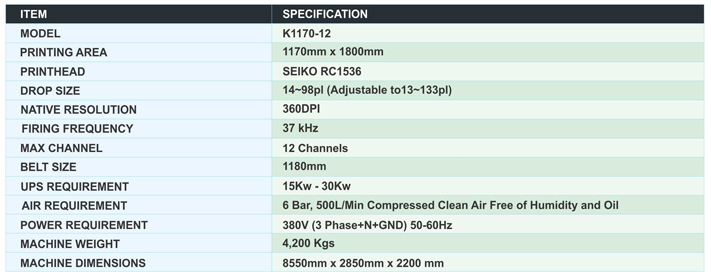
Ceramic Printer K-1170-12 Technical Specifications
| ITEM | SPECIFICATION |
|---|---|
| Model | K1170 - 12 |
| Printing Area | 1170mm × 1800mm |
| Printhead | SEIKO RC1536 |
| Drop Size | 14~98pl (Adjustable to 13~133pl) |
| Native Resolution | 360 DPI |
| Firing Frequency | 37 kHz |
| Max. Channels | 12 Channels |
| Belt Size | 1180mm |
| UPS Requirement | 15 kW – 30 kW |
| Air Requirement | 6 Bar, 500 L/Min Compressed Clean Air (Free of Humidity and Oil) |
| Power Requirement | 380V (3 Phase + Neutral + Ground) 50–60Hz |
| Technology | Digital Ceramic Inkjet Printing System |
| Applications | Ceramic Tile Printing, Decorative Ceramic Surfaces, Print on Demand Tiles, Industrial Ceramic Decoration, Wide Format & Large Format Ceramic Production |
Ceramic Printer K-1170-12 Compatible Materials & Applications
| Material / Use Case | Applications |
|---|---|
| Ceramic Wall & Floor Tiles | Wide-format wall tiles, floor tiles, and décor tiles up to 1170mm width with digital patterns and effects |
| Decorative Ceramic Surfaces | Custom motifs, marble effects, wood effects, stone effects, and artistic ceramic designs |
| Print on Demand Production | Short-run custom tiles, sample batches, and personalised ceramic designs without screens |
| Industrial Ceramic Lines | High-volume ceramic tile decoration for factories and continuous production plants |
| Wide / Large Format Panels | Large ceramic panels and wide format decorative surfaces for commercial interiors and architecture |
| Growing Print Businesses | Suitable for ceramic specialists and a small printing business expanding into digital ceramic substrates |
| Related Digital Print Workflows | Complements shops already running flex printing, flex printing machines, or printer for vinyl signage lines |
Ceramic Printer K-1170-12 FAQ
Step 1 — Ink Preparation: Ceramic inks containing glass frits, metal oxides, and mineral pigments are loaded into the ceramic printing machine. These inks are much heavier and more abrasive than the solvent inks used in flex printing machines, which is why the K-1170-12 uses SEIKO RC1536 printheads with recirculation systems that keep pigments suspended and flowing.
Step 2 — Digital Printing: The raw or pre-glazed tile is placed on the conveyor belt. As it passes under the printheads, the ceramic printer jets the design onto the tile surface using variable drop sizes (14~133pl) at 360 DPI resolution and 37 kHz firing frequency. The K-1170-12 can use up to 12 ink channels for extended colour and effects.
Step 3 — Drying: The printed tile may pass through a drying section to remove moisture carriers from the ink.
Step 4 — Kiln Firing: This is the critical step that separates ceramic printing from all other digital printing. The printed tile enters a kiln at 800–1200°C. At these temperatures, the glass frits in the ceramic inks melt and fuse with the tile surface, while the metal oxides develop their final colours. The design becomes a permanent part of the tile — scratch-resistant, water-resistant, and UV-stable.
Step 5 — Quality Check & Packing: The finished tile is inspected and packed for shipping.
The entire process from ceramic printer to finished tile takes minutes to hours depending on kiln speed. Unlike flex printing where the print is finished when it comes off the machine, ceramic printing is only complete after firing. And unlike a ceramic 3D printer which builds shapes layer by layer, a ceramic printer decorates an existing flat surface.