
Ceramic Printer KT2100 | Complete Digital Ceramic Glaze Line & Large Format Printer
Resources
Watch videos or download catalogues
Product Description
Ceramic Printer KT2100 | Complete Digital Ceramic Glaze Line & Large Format Printer
Key Points
- The complete Digital Ceramic Glaze line with Base Glaze (6 channels max) + Pigment Color (12 channels max) + Effects Glaze (12 channels max)
- Available in 1500mm width with max 28 channels & 2100mm width with max 30 channels
- Equipped with Seiko RC1536 printheads for ceramic; Effects use Seiko RC1526L; Base Glaze uses RC1536L+
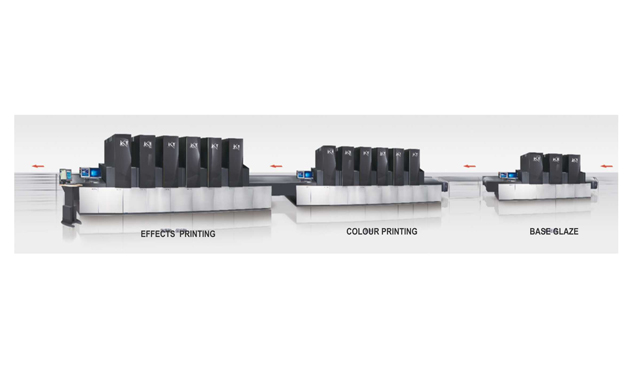
The Ceramic Printer KT2100 is not just a single ceramic printer — it is a complete digital ceramic glaze production line that applies base glaze, pigment colour, and effects glaze in one continuous pass. With a 2100mm × limitless printing area, up to 30 ink channels split across three dedicated printing stations, and specialised SEIKO printheads for each function (RC1536L+ for base glaze, RC1536 for pigment colour, RC1526L for effects), this ceramic printing machine does in one line what traditionally requires multiple machines and manual glaze application steps. For tile factories moving to full digital ceramic printing, or a small printing business ready to scale beyond flex printing, flex printing machines, or a printer for vinyl into high-value ceramic production, the KT2100 is the end-to-end solution.
The three-stage architecture is what sets this ceramic printer apart. The Base Glaze station (up to 6 channels) lays an even foundation layer. The Pigment Colour station (up to 12 channels) applies the design with 16-level greyscale processing, 360 DPI native resolution, and adjustable drop sizes from 14~98pl (up to 13~133pl). The Effects Glaze station (up to 12 channels) adds textured, metallic, or glossy effect layers on top — all before the tile enters the kiln. Powered by an 833MHz dual-core Cortex-A9 CPU with Intel Cyclone® V SoC FPGA and 8G memory, with high-flow ink circulation at 130ml/min, water bath heating, closed-loop control, 37 kHz firing frequency, and 1-second production changeover, this large format printer and wide format printer for ceramics handles the most demanding big slab and decorative tile production. Available in two widths — KT1500-28 (1500mm, 28 channels) and KT2100-30 (2100mm, 30 channels) — it scales from high-capacity production to the widest industrial ceramic formats. For print on demand custom tiles alongside high-volume standard runs, the KT2100 is the most complete ceramic printing line you can install.
Key Advantages of Ceramic Printer KT2100
✔ Complete 3-Stage Glaze Line
Base Glaze (6 channels) + Pigment Colour (12 channels) + Effects Glaze (12 channels) = one continuous line that replaces multiple machines and manual glaze steps. No other ceramic printer at this width offers a complete digital glaze workflow in a single pass.
✔ Specialised Printheads Per Function
SEIKO RC1536L+ for base glaze, SEIKO RC1536 for pigment colour, SEIKO RC1526L for effects glaze. Each head type is matched to its specific ceramic printing task — a level of specialisation that general-purpose printers cannot match.
✔ 2100mm × Limitless Print Area
The KT2100-30 handles 2100mm-wide tiles with virtually limitless length. As a large format printer for ceramics, it prints the widest big slabs and continuous panels in a single pass — no stitching, no weak joints.
✔ Up to 30 Channels with 16-Level Greyscale
30 ink channels with 16-level greyscale processing deliver rich colour, smooth gradients, and complex multi-layer effects. For a ceramic printing machine serving a factory with diverse product lines, this means running base, colour, and effects without changing ink setups.
✔ 8G Memory & Intel FPGA Processing
833MHz dual-core Cortex-A9 CPU with Intel Cyclone® V SoC FPGA and 8G memory processes the massive three-layer data files that complete glaze line ceramic printing generates — big slab designs with base, colour, and effects layers combined.
✔ 130ml/min Circulation & Smart Control
High-flow closed-loop ink circulation at 130ml/min with water bath heating, 1-second production changeover, injector blockage compensation, and colour adjustment from -100% to +100%. This digital printing equipment is built for 24/7 factory operation where consistency directly affects yield.
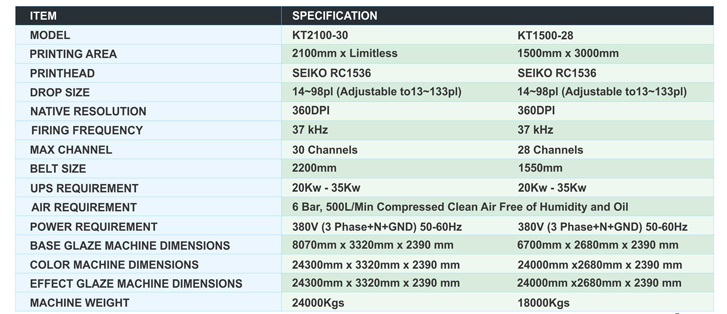
Ceramic Printer KT2100 / KT1500 Technical Specifications
| ITEM | KT2100 - 30 | KT1500 - 28 |
|---|---|---|
| Model | KT2100-30 | KT1500-28 |
| Printing Area | 2100mm × Limitless | 1500mm × 3000mm |
| Belt Size | 2200mm | 1550mm |
| Max. Channels | 30 Channels | 28 Channels |
| Printhead Type | Base Glaze: SEIKO RC1536L+ | SEIKO RC1536 / RC1536L |
| Pigment Colour: SEIKO RC1536 | — | |
| Effects Glaze: SEIKO RC1526L | — | |
| Drop Size | 14~98pl (Adjustable to 13~133pl) | 14~98pl (Adjustable to 13~133pl) |
| Native Resolution | 360 DPI | 360 DPI |
| Firing Frequency | 37 kHz | 37 kHz |
| Channel Configuration | Base Glaze: Max 6 Ch | — |
| Pigment Colour: Max 12 Ch | — | |
| Effects Glaze: Max 12 Ch | — | |
| Greyscale Processing | 16 Levels | 16 Levels |
| Ink Circulation | 130 ml/min High-Flow Closed-Loop with Water Bath Heating | 130 ml/min High-Flow Closed-Loop with Water Bath Heating |
| Processor / Memory | 833MHz Dual-Core Cortex-A9 CPU, Intel Cyclone® V SoC FPGA, 8G Memory | 833MHz Dual-Core Cortex-A9 CPU, Intel Cyclone® V SoC FPGA, 8G Memory |
| Operating Temperature | 0°C – 85°C | 0°C – 85°C |
| UPS Requirement | 20 kW – 35 kW | 20 kW – 35 kW |
| Air Requirement | 6 Bar, 500 L/Min Compressed Clean Air (Free of Humidity and Oil) | 6 Bar, 500 L/Min Compressed Clean Air (Free of Humidity and Oil) |
| Power Requirement | 380V (3 Phase + Neutral + Ground) 50–60Hz | 380V (3 Phase + Neutral + Ground) 50–60Hz |
| Technology | Single-Pass Digital Ceramic Inkjet Printing System | |
| Machine Weight | 24,000 kg | 18,000 kg |
| Base Glaze Machine Dimensions | 6700 × 2680 × 2390 mm | |
| Color Machine Dimensions | 24000 × 2680 × 2390 mm | |
| Effect Glaze Machine Dimensions | 24000 × 2680 × 2390 mm | |
*KT2100-30 is a complete 3-stage Digital Ceramic Glaze line (Base Glaze + Pigment Colour + Effects Glaze) with specialised printheads per stage. KT1500-28 is a single-stage ceramic printer. All other specifications are shared. Specifications as per product datasheet.
Ceramic Printer KT2100 Common Applications
| Application | Description |
|---|---|
| 🏠 Decorative Wall & Floor Tiles | High-volume digital decoration for residential and commercial wall and floor tiles with rich colour and effects |
| 🏢 Architectural Ceramic Panels | Large format ceramic panels for building facades, lobbies, and commercial interiors up to 2100mm width |
| 🎨 Customized Ceramic Designs | Print on demand custom patterns, artwork, and personalised tile designs without screens |
| 🏪 Brand Logos & Promotional Products | Corporate branding on ceramic surfaces for retail spaces, restaurants, and hospitality venues |
| ☕ Ceramic Mugs & Tableware | Custom printing on ceramic drinkware and dining products (with appropriate fixturing) |
| 🖼️ Photo & Artwork Printing | High-resolution reproduction of photographs and fine art on ceramic substrates |
| 🛁 Bathroom & Interior Décor | Custom bathroom tiles, shower surrounds, and interior decorative ceramic surfaces |
| 🏭 Industrial Ceramic Decoration | Continuous single-pass production for large tile manufacturing plants with base, colour, and effects in one line |
| Big Slab Ceramic Tiles | Large format floor slabs, wall slabs, and oversized decorative panels up to 2100mm width |
| Glaze Effect & Cover Inks | Heavy ink coverage above 45g/sqm for dark designs, textured effects, metallic finishes, and cover layers |
| Digital Print Expansion | For businesses moving from flex printing, flex printing machines, or vinyl print workflows into complete ceramic glaze production |